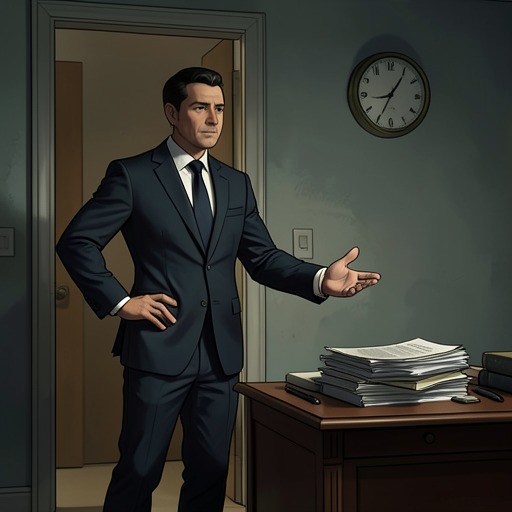
Deck Shifflet
The RainmakerDeck Shifflet enters Rudy Baylor’s working life as an unsettling contradiction: he has attended law school and knows how to build a case, yet has never passed the bar and openly practices without a license. Experienced in insurance and adept at acquiring clients, he becomes an important guide to the mechanics of legal work—and a persistent challenge to Rudy’s more idealistic understanding of the profession.
Identity and Background
When Deck first appears in Rudy’s office, he is a nervous, guarded man who slips into the room without offering a handshake. His appearance is striking: his remaining hair is slicked across his scalp, thick wire-rimmed glasses sit on his face, and his clothes are worn. His features twitch as he speaks, and he repeatedly glances around as if expecting someone to overhear him. The physical impression is of a man uneasy in the room; that apprehension will contrast sharply with the confidence he displays when dealing with potential clients.
Deck finished law school five years before their meeting, after attending night school in California while married and working fifty hours a week. It took him five years to complete the program, and his wife left him. He moved to Memphis and went on to work for Bruiser Stone for nearly three years. Before law school, he spent eighteen years at Pacific Mutual, experience that gives him particular familiarity with insurance cases. He has sat for the bar exam six times. He has not attempted it for a year and does not know whether he will try again, leaving him educated in law but excluded from licensed practice.
That exclusion is not merely a private disappointment: Deck has crossed the boundary it imposes. He admits that he has appeared in court himself and has not yet been caught. At Bruiser’s office, he finds cases, develops them, and hands over Bruiser’s share; he estimates that he can make forty thousand dollars a year practicing without a license. The firm’s arrangement is informal and competitive rather than a stable professional hierarchy: its lawyers find their own clients and retain a third of the gross. Deck describes the other attorneys as coming and going, often leaving after a year or two to open practices of their own.
His position in the office is unusual. Bruiser trusts Deck with his files and allows no one else to handle them; lawyers who have tried to interfere have been fired. Deck helps with the files and receives payment if a case settles, while remaining dependent on Bruiser’s protection because he has not passed the bar. He describes himself as harmless, a characterization that helps explain why Bruiser tolerates his presence despite the risks of his unauthorized work. To Rudy, Deck is at once a colleague with specialized experience and a reminder that legal knowledge, professional status, and actual practice do not necessarily coincide.
Recruitment and the Mechanics of Solicitation
Deck’s practical education becomes clearest when Bruiser Stone gives Rudy an accident report and tells him to obtain the injured driver as a client. The collision occurred at Airways and Shelby; the report suggested that one driver had run a red light while drunk, and both drivers had been taken to a hospital. Deck explains that Bruiser receives such reports almost every morning from contacts at the Main Precinct, then distributes them among the lawyers, who are expected to turn them into cases. For Deck, the report is not simply a record of an accident but the opening move in a race to secure a fee.
He instructs Rudy in the approach with the matter-of-fact fluency of someone who has repeated it many times. The injured driver’s home number is on the report, and Deck proposes calling under the pretense of being with the Memphis Fire Department Rescue Division so the person answering will disclose which hospital has admitted him. Rudy recoils at the suggestion that this is ambulance chasing; Deck’s answer is that a lawyer who cannot learn to pursue clients will starve. He then offers to take Rudy along, turning an abstract lesson in questionable solicitation into a visit Rudy would rather avoid.
At St. Peter’s Charity Hospital, Deck’s nervousness disappears. Using a parking card that identifies him as a physician, he gets past the lot’s guard, quickly obtains the room number at the information desk, and leads Rudy through the crowded hospital to Dan Van Landel’s room. Deck knows where to go and how to move through the institution without attracting notice. In the semiprivate room, Van Landel is badly injured: his face is bandaged, one eye is nearly swollen shut, an arm is broken, and a leg is held in traction. Rudy is acutely aware that the injured man has been approached while vulnerable and that the other patient in the room is an unwilling witness to their intrusion; Deck proceeds without hesitation.
Deck establishes an immediate division between the prospective clients and the insurance companies. He warns Van Landel not to speak with insurers, tells him the accident report shows that the other driver ran a red light, and claims that insurance investigators may bribe witnesses. He says the firm must act quickly to photograph the scene and interview witnesses before the insurers do. His confident presentation makes the firm sound already at work on Van Landel’s behalf, although the visit itself is the first step in securing his authorization.
The proposed contract makes the imbalance in the encounter especially visible. Deck describes the firm as handling more car wrecks than anyone in Memphis, promises large settlements, and says it charges nothing upfront, taking the usual one-third of any recovery. He slides a short, three-paragraph agreement into Van Landel’s hands while the injured man is groggy and in pain. Van Landel asks to wait for his wife; Deck says he can speak to her later. When Rudy accidentally catches a cable and pulls Van Landel’s leg higher, the groan and Rudy’s repeated apologies sharpen the discomfort of watching a legal agreement being pressed on a patient in that condition. Van Landel nevertheless signs, and Deck immediately gives him a business card identifying him as a paralegal for J. Lyman Stone’s law firm.
After obtaining the signature, Deck issues instructions designed to keep the new client from dealing independently with the insurers: Van Landel should speak only to his doctor, sign nothing without Deck’s review, and call him at any hour. Deck also gives him Rudy’s number and says that Rudy will return the next morning with paperwork; Van Landel’s wife is asked to call that afternoon. Deck pats the client’s uninjured leg and assures him that they will get him a large sum. The encounter has converted a police report into a signed retainer, but it leaves Rudy conscious of the cost in dignity and self-respect. On the way out, Deck treats the acquisition as routine and argues that approaching a potential client carries nothing to lose if the lawyer is turned away.
The episode gives concrete form to Deck’s account of legal practice as a trade learned outside the classroom. He contrasts law school’s theories and professional ideals with the day-to-day work of finding clients and pressing a case forward. His own ethical summary is narrower and more practical: a lawyer should fight for the client, refrain from stealing, and try not to lie. Rudy sees the gap between that compact code and the elaborate ethical principles he studied, while Deck’s successful solicitation demonstrates why those principles alone do not explain how a precarious practice survives. Deck is neither simply a capable mentor nor merely a corrupt operator: he teaches Rudy skills the formal curriculum omitted, but the lesson begins with deception and a signature obtained from a man who has scarcely had time to understand what happened to him.
Building the Case and Facing Its Risks
As the Black case moves toward trial, Deck becomes the custodian of the paper record and Rudy Baylor’s practical support. The material covers four rented folding tables in the office: 221 pages supplied by Dot Black and 748 pages produced by Great Benefit, including duplicates. Deck has spent hours on the files, prepared a detailed analysis of the claim record, and handled much of the computer work. During depositions, he is to keep the documents organized and find what Rudy needs quickly. His command of the paperwork is substantial, but he is not persuaded that the case justifies Rudy’s investment of effort. He believes they have found a smoking gun, yet worries about Rudy’s ability to try the case and about how a jury might regard fifty thousand dollars.
Deck’s doubts also help direct the investigation. He reasons that Jackie Lemancyzk, the claims handler, probably lacked authority to deny the claim outright: she would have done her job and sent the file to underwriting. The missing trail, Deck suggests, lies in the exchange between claims and underwriting, where internal memoranda should have recorded how the decision was made. That gap matters because Rudy suspects a plan to deny Donny Ray Black’s claim and many others. The case therefore depends not only on what the assembled papers show, but on locating the communications that are absent from them.
When Rudy returns from Donny Ray’s funeral, Deck and the private investigator Butch show him a listening device hidden inside an office telephone. Deck has already asked Butch to inspect the phones; matching devices are found in all three. Deck is visibly shaken, and his guarded answer when Rudy asks whether he has spoken with Bruiser Stone signals that he does not want the subject discussed in Butch’s presence. The men consider whether to remove the devices, but Butch warns that doing so would tell federal investigators they had been discovered. Instead, they return to the office, talk aloud about an unrelated case, and search tables, chairs, wastebaskets, files, vents, and baseboards for four hours. They find no other bugs. The surveillance turns their own workplace into a suspected listening environment, and Deck’s earlier nervousness now has a concrete source.
Their unequal resources are especially plain as jury selection approaches. Rudy imagines Leo F. Drummond’s team investigating all ninety-two prospective jurors through public records, credit histories, employment information, and professional jury consultants who will observe the panel in court. Rudy and Deck have no comparable operation: they plan to share questionnaire lists with Butch and Booker Kane, make calls, and check some addresses, but will mostly have to judge people by their courtroom appearance. Deck’s ability to read people becomes an asset in this improvised effort, even as the contrast exposes how little a small plaintiff’s team can do against a well-funded opponent.
On the eve of closing arguments, Deck stays with Rudy at the office while he rehearses. Rudy writes the key figures on a small chalkboard and tries different versions of his appeal; Deck interrupts, challenges him, and cuts down his occasional confidence. Neither has delivered a jury summation before, but Deck treats experience as a reason to scrutinize the performance rather than flatter it. He keeps reminding Rudy that the case can still be won or lost the next morning. His support is neither polished courtroom expertise nor simple reassurance: it is the close, sometimes abrasive attention of a partner who knows how much remains at stake.
Partnership, Separation, and Departure
Deck’s partnership with Rudy is tested when Rudy’s work on the Black case collides with the crisis surrounding Kelly Riker. After Rudy spends the night preparing divorce papers and emergency relief for her, Deck arrives at the office at seven, hears what happened, and objects that Rudy has sacrificed sleep with the closing argument less than two hours away. He fetches coffee, but Rudy’s confidence that Great Benefit will lose makes Deck suspect that the more personal prospect of helping Kelly is also driving his smile. The exchange shows their intimacy as partners: Deck can challenge Rudy sharply, read what he is reluctant to say, and still stay beside him through the demands of the trial.
When Kelly is arrested after Cliff’s death, Deck again turns anxiety into practical work. He lets Rudy sleep until five, then brings coffee and responds to Rudy’s account with certainty that no jury will convict her. He also recognizes the immediate problem: winning at trial is different from getting her out of jail. Deck helps assemble the next steps, gathering arrest records and preparing to locate the police file, while Rudy asks him to send Butch to look for witnesses near the apartment. Their work together now serves not a client’s civil claim but Kelly’s urgent defense, and Deck’s loyalty extends beyond the formal boundaries of their practice.
The firm’s eventual separation makes clear how much of Deck’s professional life depends on Rudy. They divide the files over lunch at Miss Birdie’s house. Deck takes the files he wants; Rudy is to receive two thousand dollars within ninety days, while unwanted active matters are to be sent to other lawyers and the Ruffins’ collection cases returned to Booker Kane. The accounts are modest: the firm has thirty-four hundred dollars in the bank and outstanding bills, while Rudy has saved twenty-eight hundred dollars. Six months of work have produced few cases and clients. Their business arrangements are easy to settle, but the personal division is not. Deck cannot pass the bar exam, has no independent place to practice, and will spend a few weeks cleaning up Rudy’s files; both men understand that he cannot operate without a licensed lawyer to stand in front of him.
Deck admits that gambling has left him broke. He has been losing money at the casinos, even though he and Rudy had each put two thousand dollars into the firm after receiving equal shares of the Van Landel settlement. Deck’s financial trouble is joined to a much riskier temptation: Bruiser Stone has contacted him from the Bahamas, where Bruiser and Prince Thomas have escaped, and told him that four million dollars taken from the clubs remains hidden in a Memphis warehouse. For a ten-percent share, Deck is considering transporting it to Miami in a small rented truck. Rudy warns him not to do it, but Deck is already persuaded that the federal investigators are no longer watching and does not seem to hear the danger in his own plan. The old pattern of unauthorized work and precarious survival now points toward a criminal venture that Rudy refuses to join.
Before they part, Deck helps Rudy carry clothes to his car. He says he does not blame Rudy for leaving, and tells him, “You made history, Rudy, do you know that?” Rudy answers that they did it together. They can claim the achievement even if the partnership has little money to show for it. They embrace, nearly choking up, then shake hands; Deck’s eyes are wet as he shuffles down the drive and leaves with Butch. The farewell holds both the limits and the depth of their alliance: Deck has been Rudy’s guide to the unschooled mechanics of law, his document-keeper and workroom critic, and a friend, but their futures separate at the point where Rudy turns away from Bruiser’s hidden money. Deck’s final image is not of courtroom authority but of the unlicensed, unsettled man walking away from the only practice he could not have sustained alone.